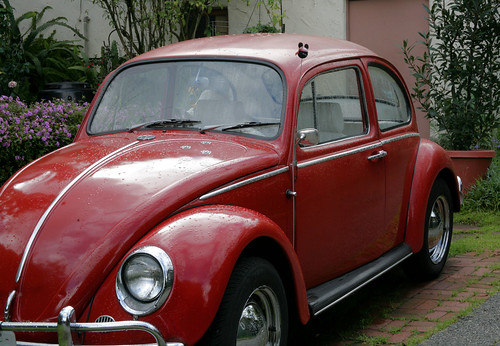
It was inevitable, I suppose, but I wasn’t expecting it. I thought I’d repaired everything there was that could go wrong on this car. I replaced the transaxle, the fuel pump, the distributor, the ignition coil, the brake master cylinder, , the accelerator pedal, the shift lever, the emergency brake lever, the heater control cables, the carburetor, the alternator, the tires, the front axle torsion bars, even the radio. What else could possibly go wrong with this car? The only component left, really, was the engine and that seemed to be ticking along just fine. Sure it had always had a strange rattling sound when it was running, but the sound never changed. It was the same sound every time you fired up the engine. It always sounded as if something were loose inside the crankcase, but the sound never got louder or softer. It was always the same . . . until the other day when it wasn’t.
I was out in the back yard messing around in the garden, or working on the Baja Bug, I don’t remember which, when Carol came out to start up the Red Car and head off somewhere. I said goodbye, have a safe trip as she passed. I heard the car door slam and then I heard the starter try and fail to turn the engine over. Okay, I thought, that’s not so good. Carol abandoned the Red Car and took another of our vehicles for her journey. I went on about whatever I was doing – adjusting valves on the Baja Bug, now that I think about it. I was guessing that it was a dead battery that was the cause of the Red Car’s failure to start, so, later that day, I ran an extension cord out the back door and hooked up the battery charger to the Red Car’s battery. I left it to charge overnight and figured I’d do the diagnosis the next morning.
The next day I went out to check on the status of the battery. It appeared to be all charged up, so I unhooked the charger, put it away, then rolled up the extension cord and hung it back up in the basement. I moved the Baja Bug out of its spot behind the basement door so I could put the Red Car there for testing, and then went over to the Red Car, adjusted the seat so that I could get behind the wheel, climbed in and put the key in the ignition. When I turned the key, I heard the very same sound that I had heard the day before. The starter engaged the flywheel and then failed to turn the engine. Well, then, that would seem to be Symptom Number 1 in the diagnosis. I released the parking brake but left the car in gear and then climbed back out and tried to rock the car a bit to break things loose. It wouldn’t rock and it certainly wouldn’t roll. Here we had Symptom Number 2 in the diagnosis. I was now suspecting that the engine has seized. I went back into the basement to get a big adjustable wrench to try to turn the engine over by hand. I was able to move the engine backwards and then forward a bit. I set the wrench aside, climbed back into the car and this time was able to get it started. It seemed to be running just fine and that rattling noise was still there and unchanged. I backed the car up into the space behind the basement door, set the brake, and climbed out, leaving the engine running. One thing I noticed immediately was that the belt that drives the alternator and the fan was shaking quite violently. Other than that, and the ever-present rattle, there was no obvious indication of any other problem. I shut off the engine.
What would cause that belt to shake like that? Well, perhaps one of the pulleys was wobbling a bit. No, that didn’t seem to be the case. I took off the drive belt so I could see if there was some sort of wobble in the crankshaft pulley. As I pulled and pushed on that pulley on the end of the crankshaft I could feel and hear the crankshaft moving back and forth inside the case. Diagnosis: crankshaft bearings are worn out causing excessive heat which, in turn, caused the engine to seize.
Decision time. I had gotten the thing started and it seemed to be running just fine. Do I send Carol off driving around, knowing that at some point the engine will again seize, leaving her stranded somewhere. Do I take the chance of a catastrophic failure of the engine thereby ruining the engine case and whatever else might be in the way when parts start flying around? The answers seem rather self-evident to me. I should leave the car right where it is and order a new engine. That seemed to be the most optimum thing to do at that point, so that’s what I did. It’s in the perfect spot for me to work on right now. It’s not in the way of any other projects. So, the poor dead thing can just sit there and wait until the rebuilt engine is done and I have time to make the swap.
It does leave us to wonder, Carol and I, if this car is worth all the trouble it has caused us. Just when we think we’ve replaced everything that can break, something like this happens. Once the engine has been replaced, though, there really isn’t any part of the running gear that hasn’t been brought up to standards. Still, cars have moving parts which wear out, and this is a 1965 VW we’re talking about, so inevitably sometime in the future something else will fail on this car. I have to maintain a rather philosophical attitude about this car; otherwise I’d be tempted to have the thing hauled off to the junk yard and crushed in order to keep anyone else from having to go through what we’ve gone through with it.



 Posts
Posts


